.svg)
HUB
/ Blogs /
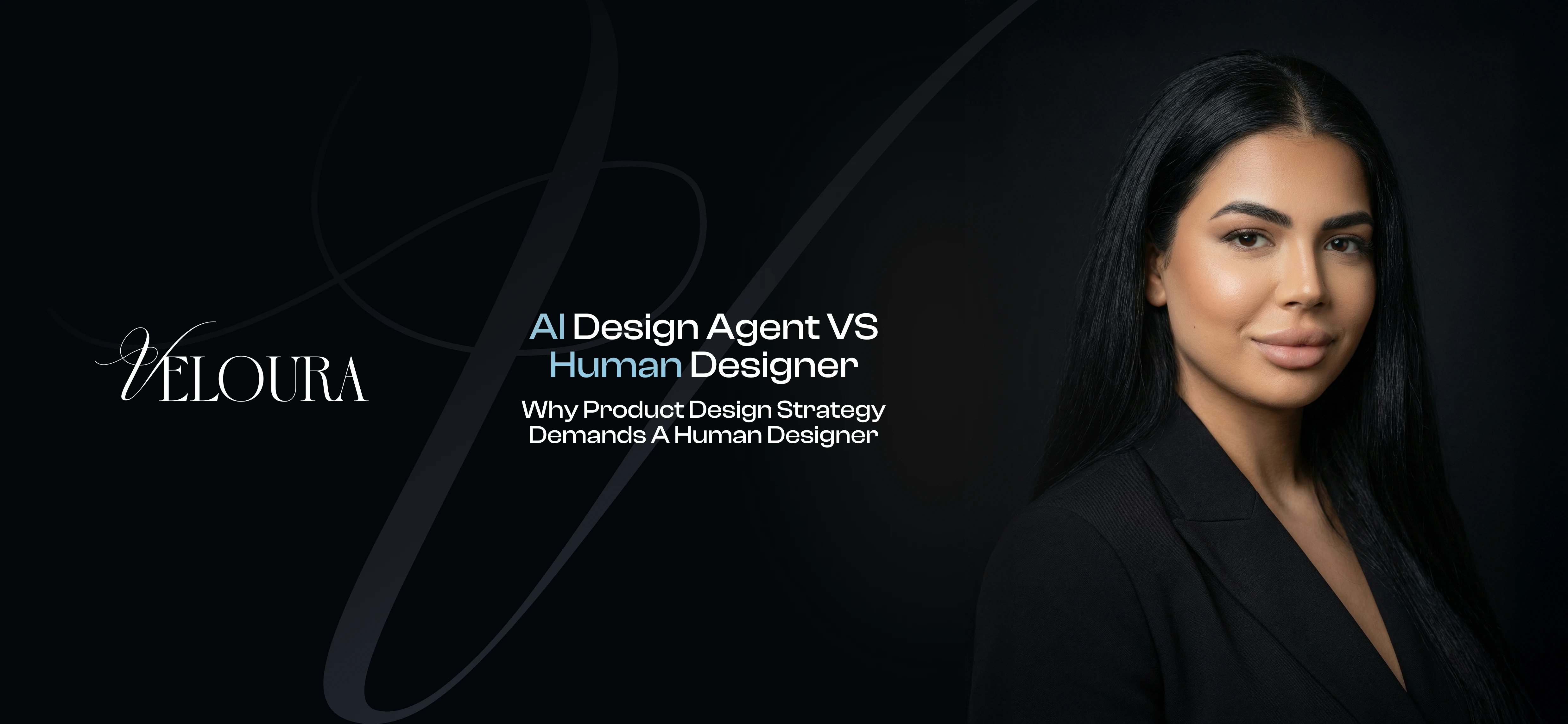
AI Design Agent vs Human Designer: Mila Pavlovic on Why True Product Design Demands a Human Designer
The digital product landscape is moving at an unprecedentedspeed. With generative artificial intelligence promising to automate everything from wireframing to high-fidelity UI rendering, business leaders face a critical question: Do we still need to invest in premium human talent, or can an algorithm build our next breakthrough application?
To answer this question, we must look beyond the marketing hype of automated tooling and examine the underlying mechanics of product success. Mila Pavlovic, a veteran senior designer, design mentor, and co-founder of Veloura Solutions, has spent years navigating the intersection of user experience, business logic, and creative execution. Her perspective cuts through the noise of the industry, offering a grounded, strategic blueprint for brands that want to scale without losing their soul.
When evaluating the trajectory of modern platforms, the debate is not merely about choosing between automated efficiency and manual execution. Instead, it centers on the difference between generating a layout and architecting an intentional human experience.
AI Design Agent vs Human Designer: Intention vs. Generation
When discussing the core divergence between an automated AI design agent vs human designer, the entire debate can be distilled down to a single word: intention. Artificial intelligence has proven itself to be a magnificent assistant to have by your side, but it remains a remarkably poor strategist.
Where Digital Automation Shines
There is no denying that modern automated tools are unbeatable when it comes to raw operational speed. If a product designer needs to quickly generate a dozen variations of an initial logo concept, establish a baseline direction, or map out standard, repetitive workflows, technology eliminates the anxiety of staring at a blank canvas.
Mila finds these tools incredibly useful for bypassing the initial friction of production. Automation excels at:
- Rapidly mapping complex user journeys and drafting foundational flows.
- Optimizing visual assets across multiple aspect ratios and device profiles.
- Handling repetitive, low-leverage user interface tasks that historically consumed hours of production time.
- Generating quick layout variations to jumpstart brainstorming sessions.
Where the Machine Falls Short
The fatal flaw of algorithmic generation is that it possesses no real context, and it fundamentally fails to comprehend human psychology. Generative tools recycle average solutions built on historical patterns of what already exists on the web. They synthesize historical data without ever asking why a specific solution worked in the first place.
An automated system can generate visually striking screens that immediately captivate an executive stakeholder. However, looking beautiful does not equate to solving a user problem.
When teams rely solely on automated outputs, they often bypass the entire user experience validation process. They ignore the foundational logic of the layout simply because the initial render was delivered in ten seconds.
Why the Expert Human Designer is Irreplaceable
Authentic product design is engineered explicitly for real human users. It relies on deep empathy, verified user experience principles, and an intimate understanding of human behavior tailored to a highly specific audience profile.
Every single pixel, every nuanced user flow, and every deliberate section of empty whitespace must exist for a specific reason. A machine cannot understand that reason; only a seasoned human designer can.
An algorithm can easily output a screen that looks pristine, but a human expert creates a comprehensive, cohesive experience. A human professional builds a system that solves a highly specific operational problem, strikes the exact emotional note required to build brand equity, and seamlessly guides the user toward a conversion goal.
Humans possess the capacity to understand user frustration, whereas a machine can only mimic the visual patterns associated with it.
Product Design That Scales: How the Best Product Designer Drives Growth
A common misconception among early-stage startups is that building a scalable platform simply requires assembling a massive, perfectly organized UI kit in Figma. While clean file architecture is valuable, real product design that scales is deeply rooted in business growth strategy and macro-level corporate logic.
True scalability demands a robust structural architecture, but it also requires the fluid flexibility to adapt as your user base expands and their daily habits evolve. The conversation must shift away from purely aesthetic variables and focus directly on core business metrics:
- User Retention Profiles
- Conversion Funnel Optimization
- Long-Term Engagement Loops
- Customer Acquisition Cost Mitigation
This level of strategic engineering is exactly why automated models struggle to scale products effectively. Algorithms learn exclusively from historical datasets, optimizing for what has already happened in the past.
Scaling a disruptive digital product, however, requires the ability to see around corners. It demands that a senior leader anticipates what a user will need long before the user can articulate it themselves. It requires making definitive judgment calls in ambiguous environments where the quantitative data goes quiet.
An algorithm cannot design a proprietary growth loop. It cannot recognize when intentionally adding friction to a user journey is actually the correct strategic decision for long-term user retention. That type of forward-thinking vision is an exclusively human capability, requiring the experience of the best product designer you can bring to your team.
The Role of a Digital Product Design Consultant: Understanding What the Client Doesn't Say
The responsibilities of an elite product design consultant extend far beyond drawing interfaces or presenting polished slide decks. The reality of high-level consultancy is that it is a rigorous, diagnostic discipline.
When corporate leaders seek out the best product design consultant, they rarely present the actual root cause of their business issues. Instead, they come to the table describing symptoms. A client might state that they need a brand-new onboarding flow, or they might express panic because their active user metrics are steadily dropping.
A digital product design consultant does not simply take those requests at face value and start wireframing. Their job is to dig beneath the surface, run deep diagnostics, and uncover the structural problems causing those symptoms.
- Consultative Phase: Discovery
- Traditional Feature Focus: Asking for a list of features to build.
- Strategic Diagnostic Focus (Mila's Approach): Analyzing the underlying business model and ecosystem.
- Consultative Phase: Problem Solving
- Traditional Feature Focus: Re-skinning a broken user interface.
- Strategic Diagnostic Focus (Mila's Approach): Aligning multi-departmental goals to eliminate friction.
- Consultative Phase: Communication
- Traditional Feature Focus: Accepting every client prompt literally.
- Strategic Diagnostic Focus (Mila's Approach): Reading the room, navigating internal politics, and building trust.
This consultative framework highlights the exact human element where artificial intelligence fails the test. An automated system is built to answer the explicit questions you place directly in front of it. A human consultant, by contrast, determines the right questions to ask in the first place.
An automated tool cannot read the room during a high-stakes executive meeting. It cannot decode the subtle internal politics shifting between a client's engineering and marketing teams, and it certainly cannot build genuine, lasting human trust.
The ability to actively listen, negotiate diplomatic compromises, guide a client away from costly mistakes, and occasionally tell an executive that their initial idea will not work is a deeply human skill set. No prompt engine can replicate the psychological safety built by an expert consultant.
Digital Product Design for Luxury Brands: The Premium Human Designer Perspective
Designing premium digital ecosystems presents a unique challenge that breaks almost all traditional software paradigms. What makes a digital product feel genuinely luxurious?
In the premium product sector, luxury is not achieved by adding features, decorations, or flashing animations. It is defined by the absolute elimination of everything that is not entirely essential. In the digital space, true luxury lives in silence, flawless typography, perfect negative space, and incredibly subtle micro-interactions.
Whether you are architecting a premium fintech platform for high-net-worth individuals or a high-end mobility application, luxury thrives on an atmosphere of exclusivity, confidence, and absolute control.
This specific niche highlights a massive divide between automated generation and elite human craftsmanship. By its very architectural nature, artificial intelligence tends to over-design.
When you prompt an automated system to generate something luxurious, it immediately defaults to highly predictable, uninspired industry clichés. It introduces excessive gold gradients, unnecessary dark textures, and overcomplicated layouts. The system attempts to look expensive rather than making the experience feel premium.
A master human designer understands the complex art of cultural restraint. They recognize that dark luxury aesthetics and clean Scandinavian minimalism depend entirely on the empty space that allows the primary content to breathe.
Artificial intelligence does not grasp these subtle cultural nuances, nor does it comprehend the emotional gravity of premium quality. It does not know how to craft a digital layout that feels inherently confident precisely because it chooses to be quiet.
When to Hire a Product Design Manager Consultant to Scale Internal Teams
As a design mentor and co-founder of Veloura Solutions, Mila Pavlovic does not just apply these principles to her client portfolio; she actively embeds them into the next generation of creative professionals.
Modern tech requires strategic leaders who understand the business mechanics of tech architecture, user psychology, and executive communication.
When enterprises reach a stage of rapid market expansion, they frequently need to hire product design manager consultant experts to establish internal design cultures, structure cross-functional workflows, and bridge the communication gap between product teams and C-suite executives.
True mentorship involves training professionals to think like business partners rather than pixel pushers. It centers on teaching designers how to defend their strategic choices using behavioral economics, psychological principles, and data-driven logic rather than subjective aesthetic preferences.
Work with the Best Product Design Consultant for Your Next Corporate Initiative
In an industry flooded with rapid production loops and automated templates, standing out requires an intentional commitment to premium quality, business logic, and human-centric execution.
Beautiful layouts are easily generated, but a sustainable digital ecosystem that drives long-term business equity must be carefully built from the ground up.
If your product requires a comprehensive structural diagnosis, an architecture engineered to scale efficiently, or a sophisticated digital execution that resonates with a luxury audience, look to established leadership.
Connect with Mila Pavlovic to explore how her extensive experience as a digital product design consultant and co-founder of Veloura Solutions can transform your platform from a collection of screens into a high-performing growth engine.
Discover more insights, review contemporary case studies, and discuss upcoming strategic initiatives by connecting directly through social channels.
- Professional Network: Mila Pavlovic on LinkedIn
- Creative Updates: Mila Pavlovic on Instagram
- Behance Portfolio: Mila Pavlovic on Behance

Ready to Reignite, Rebrand & Rise?
Let’s Talk About Where Your Brand Is — And Where It’s Meant To Go.